

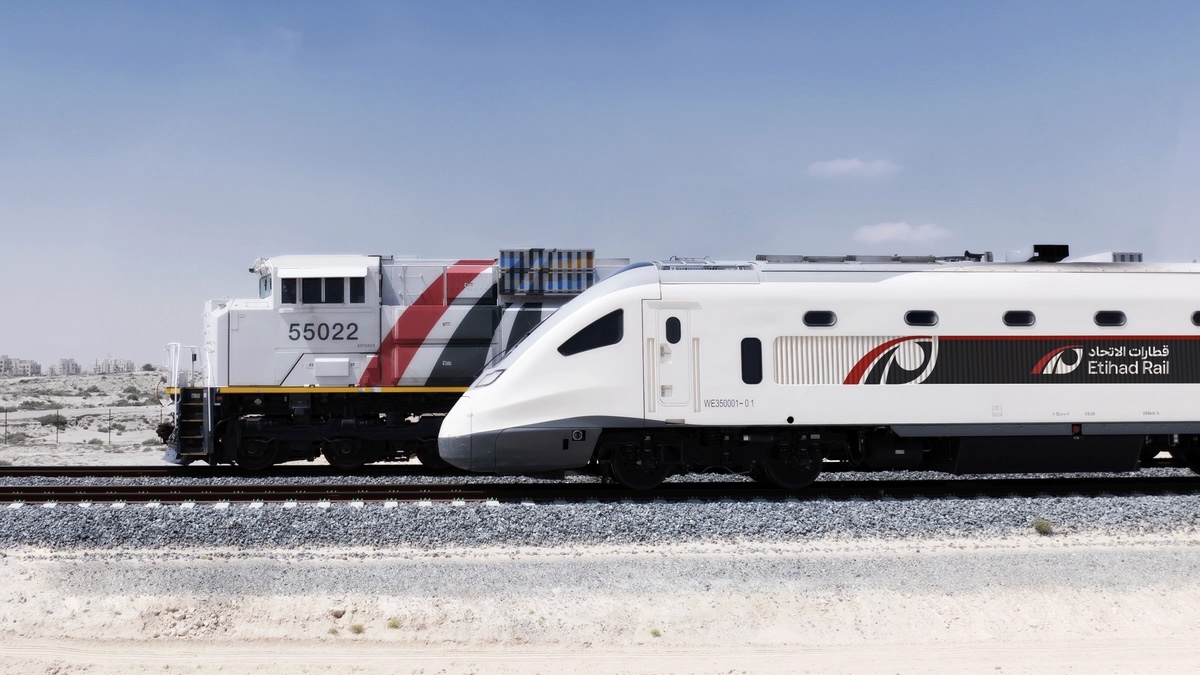
In early 2026, something quietly revealing happened. With flights temporarily suspended, the UAE turned to its still-emerging national railway. Etihad Rail operated several special passenger services between the Saudi border and Abu Dhabi, bringing more than 350 people home. It was neither a grand launch nor part of the official timetable – simply trains doing what trains are meant to do. Yet the moment offered a glimpse of the network’s potential: a system ready to move people when it matters most.
The story of Etihad Rail began in 2009, when the UAE set out to build a national railway to move goods across the country more efficiently. The first operational section opened in 2016, stretching 264 kilometers between the Shah and Habshan gas fields and the port of Ruwais. These early trains hauled sulfur from inland facilities to the coast, reducing thousands of truck journeys along the highways.
It was a small start, but an important one. Freight railways rarely attract headlines, yet they form the backbone of many national economies. In the UAE, this first phase showed that a railway could fit naturally into the country’s logistics network.
The story of Etihad Rail began in 2009, when the UAE set out to build a national railway to move goods across the country more efficiently. The first operational section opened in 2016, stretching 264 kilometers between the Shah and Habshan gas fields and the port of Ruwais. These early trains hauled sulfur from inland facilities to the coast, reducing thousands of truck journeys along the highways.
It was a small start, but an important one. Freight railways rarely attract headlines, yet they form the backbone of many national economies. In the UAE, this first phase showed that a railway could fit naturally into the country’s logistics network.
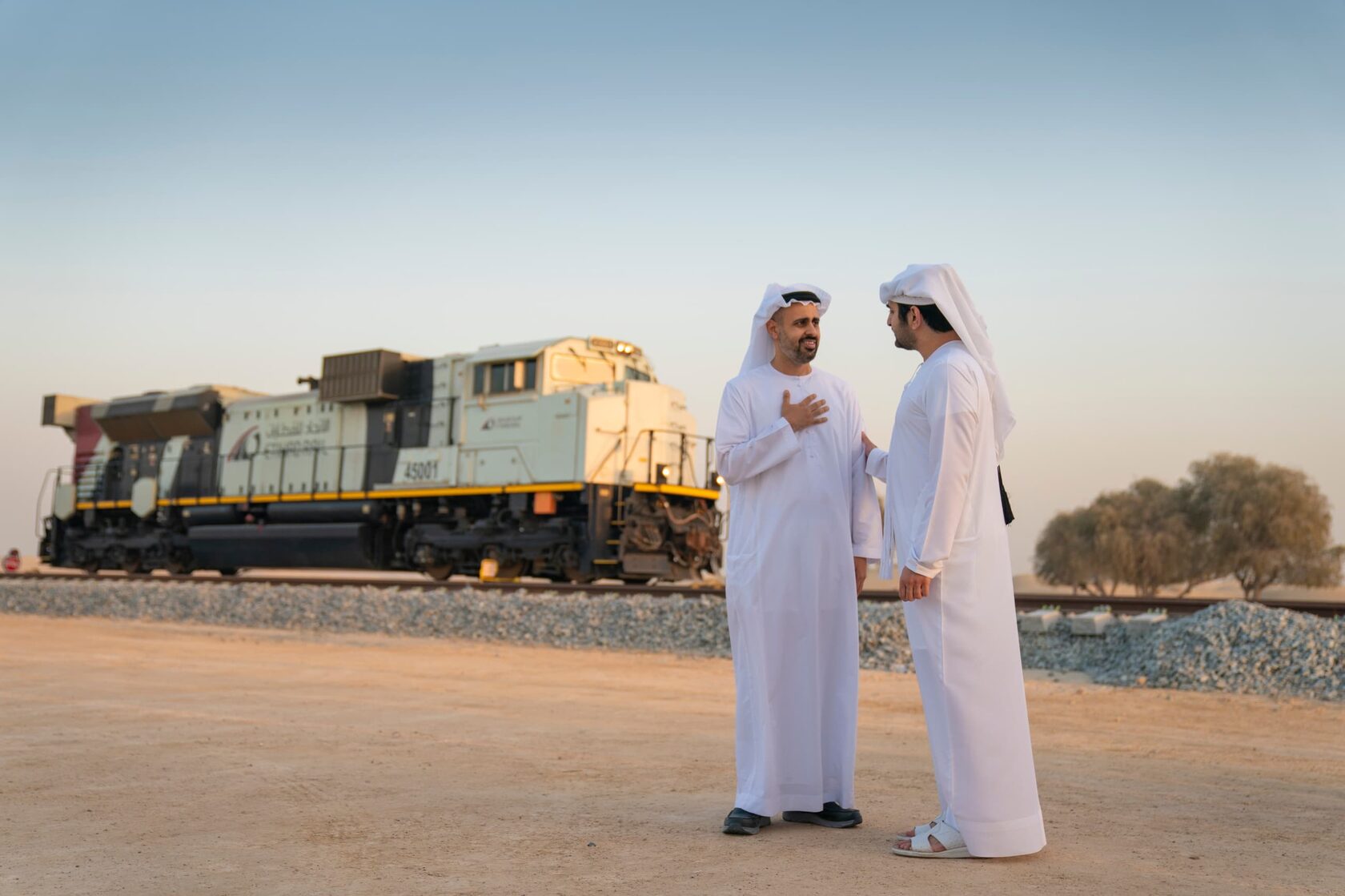
H.H. Sheikh Theyab bin Mohamed bin Zayed Al Nahyan and H.H. Sheikh Maktoum bin Mohammed bin Rashid Al Maktoum witness the connection of Abu Dhabi and Dubai with a direct railway, 2022
The next stage expanded that idea dramatically. Construction on Phase Two began in 2020, extending the line across the country. By 2023, the full freight network had reached about 900 kilometers, linking the Saudi border at Al Ghuweifat to Fujairah on the eastern coast and connecting ports, industrial zones, and logistics hubs across emirates.
The idea of passenger travel has been part of the project from the beginning, even if it arrives later in the story. Plans for the national passenger service promise to make travel between major cities much quicker. Passenger trains are designed to run at speeds of up to 200 km/h, cutting travel times significantly. A journey between Abu Dhabi and Dubai, for example, is expected to take about 57 minutes once services begin.
Economically, the network also strengthens the country’s internal connections. Faster and more predictable logistics help industries move goods more efficiently, from factories to ports and from ports to markets. Businesses benefit from shorter delivery times and more reliable supply chains, while exporters gain smoother access to shipping routes.
Tourism may also gain a new dimension. For visitors, trains offer a different rhythm of travel – a chance to move between landscapes without the pace of airports or highways. A journey across the UAE could mean watching the desert stretch past the window before arriving on the eastern coast or in the middle of a city.
The idea of passenger travel has been part of the project from the beginning, even if it arrives later in the story. Plans for the national passenger service promise to make travel between major cities much quicker. Passenger trains are designed to run at speeds of up to 200 km/h, cutting travel times significantly. A journey between Abu Dhabi and Dubai, for example, is expected to take about 57 minutes once services begin.
Economically, the network also strengthens the country’s internal connections. Faster and more predictable logistics help industries move goods more efficiently, from factories to ports and from ports to markets. Businesses benefit from shorter delivery times and more reliable supply chains, while exporters gain smoother access to shipping routes.
Tourism may also gain a new dimension. For visitors, trains offer a different rhythm of travel – a chance to move between landscapes without the pace of airports or highways. A journey across the UAE could mean watching the desert stretch past the window before arriving on the eastern coast or in the middle of a city.
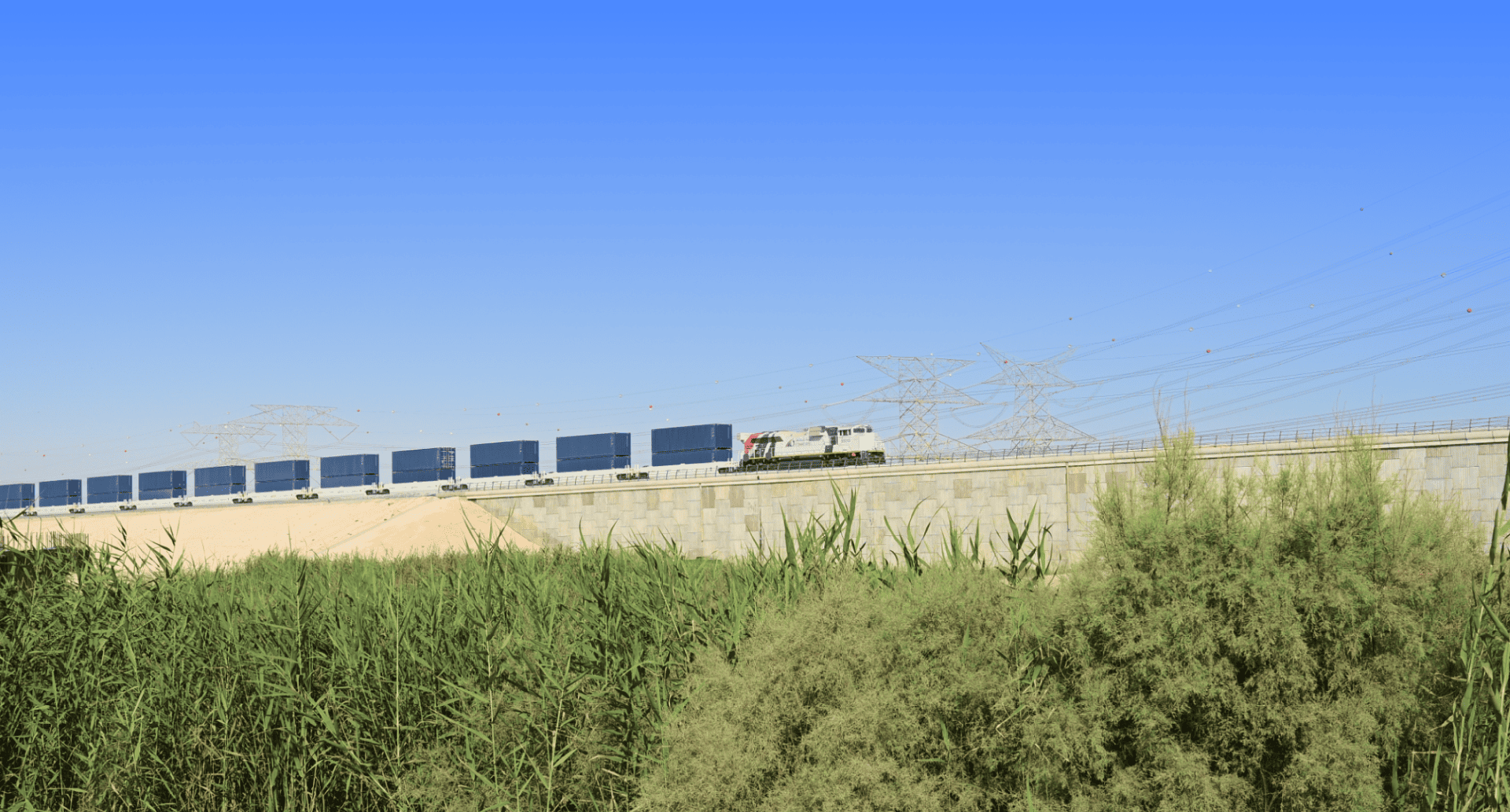
Today, freight services are already running regularly along the national railway. Passenger services are scheduled to launch in phases from 2026, forming the UAE’s first nationwide inter-city rail system connecting 11 cities and regions across all seven emirates. Stations have already been announced in locations including Mohamed bin Zayed City in Abu Dhabi, Jumeirah Golf Estates in Dubai, University City in Sharjah, and Al Hilal in Fujairah, alongside several new stops across the western region of Abu Dhabi. Each passenger train is expected to carry more than 400 travellers, with a mix of first-class, business, and economy seating.
There are also plans to extend the railway beyond the country’s borders. A major cross-border project known as Hafeet Rail is under development, linking Abu Dhabi with Sohar Port in Oman through a new line of roughly 238–303 kilometers. The connection is expected to support both passenger and freight travel and strengthen trade between the two countries.
Looking further ahead, the national railway could eventually become part of a wider Gulf rail network, connecting the UAE with neighbouring countries across the GCC. The special passenger run earlier this year offered a simple preview. A train leaving the Saudi border, arriving in Abu Dhabi, families stepping onto the platform greeted with flowers. Just a reminder that sometimes infrastructure shows its value in the most human moments.
There are also plans to extend the railway beyond the country’s borders. A major cross-border project known as Hafeet Rail is under development, linking Abu Dhabi with Sohar Port in Oman through a new line of roughly 238–303 kilometers. The connection is expected to support both passenger and freight travel and strengthen trade between the two countries.
Looking further ahead, the national railway could eventually become part of a wider Gulf rail network, connecting the UAE with neighbouring countries across the GCC. The special passenger run earlier this year offered a simple preview. A train leaving the Saudi border, arriving in Abu Dhabi, families stepping onto the platform greeted with flowers. Just a reminder that sometimes infrastructure shows its value in the most human moments.
Photo courtesy Etihad Rail