

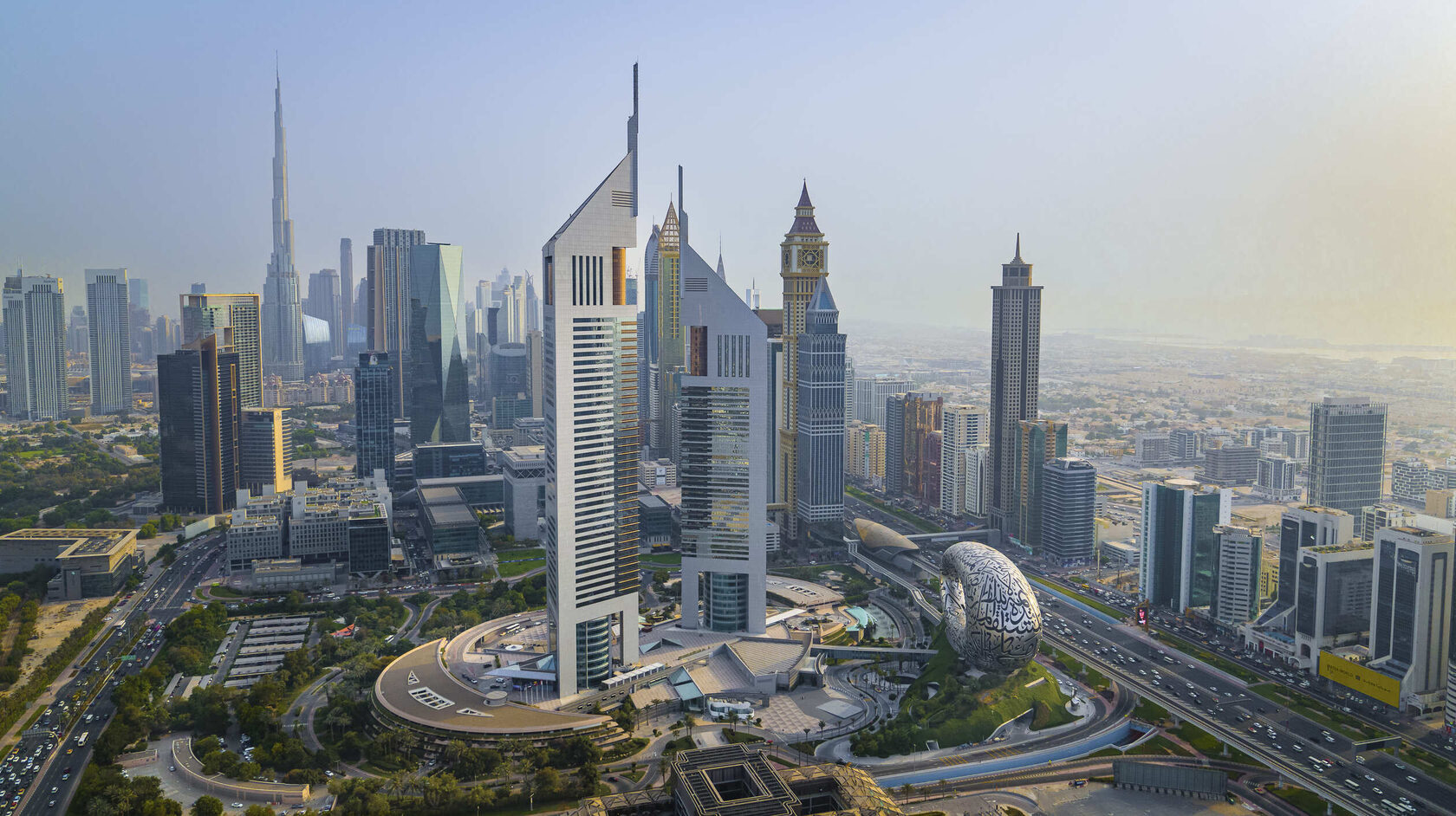
Some buildings are destined to set the tone for what follows. Rising along Sheikh Zayed Road at the turn of the millennium, these two geometrical siblings appeared at a moment when Dubai was still assembling its identity — and helped fix it in place.
Construction began in 1996, with completion by 1999 and opening shortly after. The project introduced a new scale and a new clarity. Two towers, not identical but deliberately paired: the Emirates Office Tower and the Jumeirah Emirates Towers. One for business, one for hospitality. Together, a statement about what the city was becoming — two directions it chose to pursue fully.
The complex is owned by Dubai’s Ruler, H.H. Sheikh Mohammed bin Rashid Al Maktoum, placing it directly within the emirate’s governing and strategic vision rather than purely private development. In some sense, it is policy expressed vertically.
Designed by Hazel Wong, Emirates Towers are based on triangular geometry — two sharp forms rising cleanly from a shared podium. The office tower reaches about 355 meters, the hotel slightly lower, yet both maintain a visual balance. The façade — silver aluminium and reflective glass — avoids ornament in favour of surface and light. Even today, among far more complex silhouettes, they remain instantly legible.
Construction began in 1996, with completion by 1999 and opening shortly after. The project introduced a new scale and a new clarity. Two towers, not identical but deliberately paired: the Emirates Office Tower and the Jumeirah Emirates Towers. One for business, one for hospitality. Together, a statement about what the city was becoming — two directions it chose to pursue fully.
The complex is owned by Dubai’s Ruler, H.H. Sheikh Mohammed bin Rashid Al Maktoum, placing it directly within the emirate’s governing and strategic vision rather than purely private development. In some sense, it is policy expressed vertically.
Designed by Hazel Wong, Emirates Towers are based on triangular geometry — two sharp forms rising cleanly from a shared podium. The office tower reaches about 355 meters, the hotel slightly lower, yet both maintain a visual balance. The façade — silver aluminium and reflective glass — avoids ornament in favour of surface and light. Even today, among far more complex silhouettes, they remain instantly legible.
For a period, they were the tallest buildings in Dubai. That status didn’t last, but their clarity did. They sit on Sheikh Zayed Road not as part of any particular cluster, but as a pair — a composition that still reads as complete.
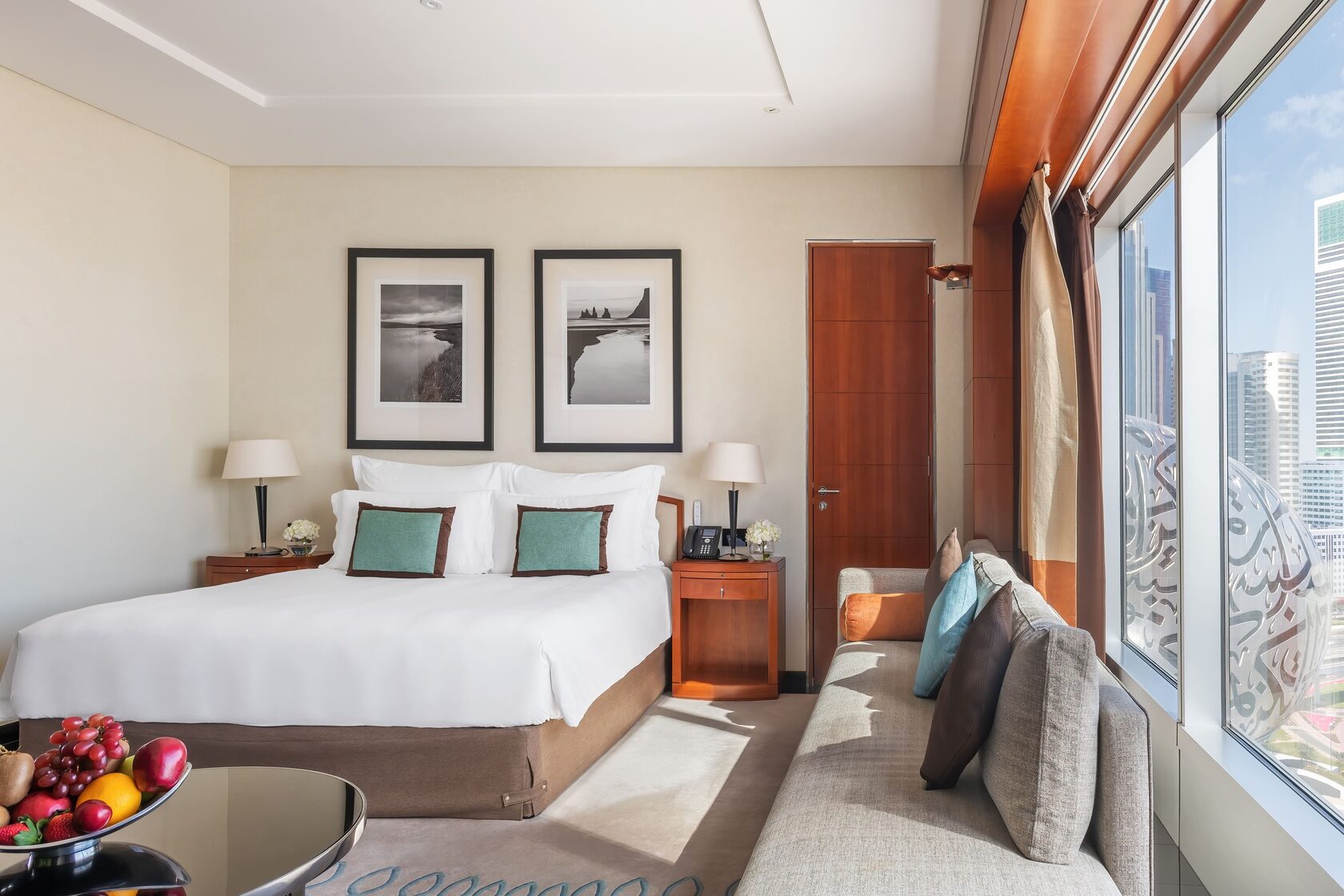
The office tower became one of the city’s early corporate anchors, housing financial institutions, multinational companies, and government-linked entities. The hotel, operated under the Jumeirah Group, positioned itself as a five-star business hotel — efficient, central, and integrated into the working life of the city.
Their symbolic role was always clear. Emirates Towers appear — quite literally — on UAE currency. The newer 500-dirham note includes the towers as part of a skyline composition alongside other national landmarks, reflecting their role as an enduring visual shorthand for Dubai’s rise. That placement signals recognition at a national level: these buildings are part of the country’s narrative.
The office tower became one of the city’s early corporate anchors, housing financial institutions, multinational companies, and government-linked entities. The hotel, operated under the Jumeirah Group, positioned itself as a five-star business hotel — efficient, central, and integrated into the working life of the city.
Their symbolic role was always clear. Emirates Towers appear — quite literally — on UAE currency. The newer 500-dirham note includes the towers as part of a skyline composition alongside other national landmarks, reflecting their role as an enduring visual shorthand for Dubai’s rise. That placement signals recognition at a national level: these buildings are part of the country’s narrative.
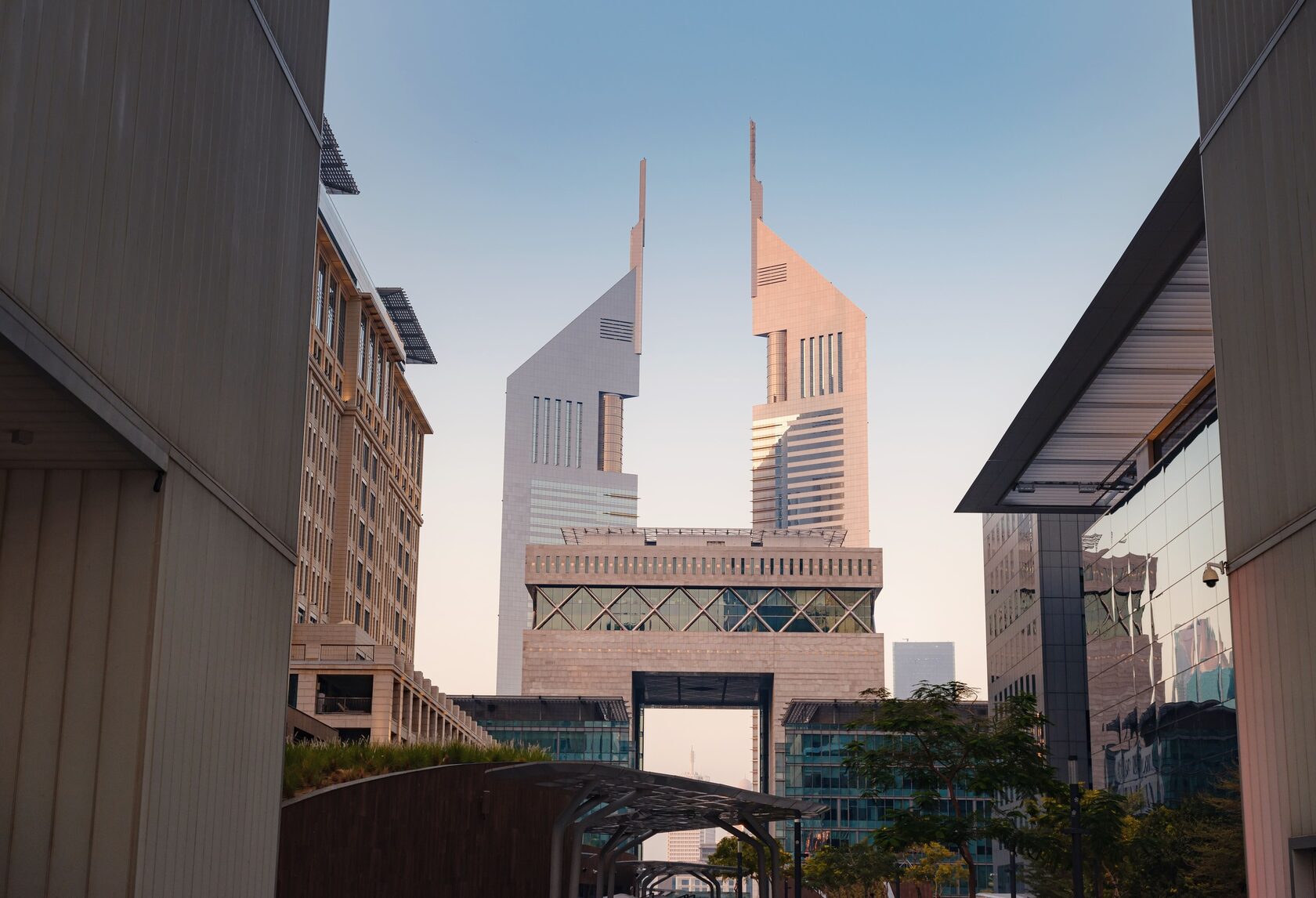
Photo courtesy Jumeirah Group
They are also unusually restrained next to their surroundings. No thematic excess, no spectacle layered on top of structure. Just proportion, alignment, and intent. While Dubai would later experiment with form in every direction, Emirates Towers remain disciplined.
Their relevance today comes from that discipline. They don’t compete with newer landmarks. They don’t need to. Instead, they operate as a reference point — a reminder of the moment Dubai finally shifted towards what it was destined to become.
Their relevance today comes from that discipline. They don’t compete with newer landmarks. They don’t need to. Instead, they operate as a reference point — a reminder of the moment Dubai finally shifted towards what it was destined to become.